
Daily Weather Alarm - Radar review
 Analysis by GetAllApps
I judge a weather app by whether it helps me make a decision before the weather becomes a problem: take a jacket, move a walk earlier, or leave extra time for a wet commute. Daily Weather Alarm - Radar is positioned for that everyday role, and its current release is version 1.4.0. It is a free weather app from X5 Network Area, aimed at people who want a quick daily check rather than a complicated forecasting workspace.
What the current release is good for
The app sits in a crowded category where many alternatives compete with detailed maps, hourly charts, alerts, and elaborate widgets. Its appeal is the straightforward idea of keeping daily weather information close at hand. That can be useful if your routine depends on a simple question—whether conditions look suitable for the trip ahead—without turning every forecast check into a research session.
I would treat it as a practical starting point, not as a complete planning system. A brief glance can help with ordinary choices, but the name alone is not enough reason to assume that every radar or alarm feature will suit a particular need. For important plans, I would check the forecast details available in the app and compare them with another trusted source when local conditions are uncertain.
The app has a 3.0 average from 294 ratings, alongside 49 written reviews. That is a mixed reception rather than a strong signal that it will work equally well for everyone. I would read that as a reason to try it for your own routine and judge whether its presentation and information are useful on your device, rather than relying on a headline score.
It has reached over 100,000 installs, which suggests it has found an audience, though popularity alone does not establish forecast quality. The age rating is Everyone, and the app is free. It requires Android 8.0 or later, so checking compatibility before installing is sensible, especially on an older phone.
A realistic daily workflow
Imagine you are getting ready for work and deciding whether to walk to the station or take a different route. A quick weather check is valuable when it answers the practical question promptly. I would open the app before leaving, review the conditions for the relevant part of the day, and make the decision while there is still time to adjust. The useful habit is not simply looking once; it is checking again if your plans shift several hours later.
For a parent planning school pickup, the same approach can help with clothing and timing. For a dog owner, it can inform whether to take a short outing now or wait. These are modest decisions, but they are exactly where a daily weather tool earns its place: by reducing avoidable guesswork without demanding much attention.
A useful tip is to check the forecast at the point when it can still change your plan, rather than only after you are already on the way. If the app’s display makes it easy to understand the coming conditions, that habit can be more useful than repeatedly opening a more complex service. If you need minute-by-minute confidence for a time-sensitive outdoor event, though, I would not rely on a simple daily glance alone.
How it fits among weather alternatives
Compared with a phone’s built-in weather panel, a dedicated app can be worthwhile when it presents the information in a way that fits your routine better. Compared with specialist forecasting tools, a daily-focused app may be easier to approach but is not automatically the better choice for detailed map analysis or close monitoring of changing conditions. The right comparison is not the number of screens; it is whether the information you need is clear enough to act on.
If you mostly want a quick check before commuting, a lightweight daily tool may be more comfortable than a service packed with layers and technical charts. If you plan hikes, boating, photography, or outdoor work, you may prefer an alternative that makes its forecast sources, map controls, and detailed timing especially clear. I would choose based on the consequence of getting the decision wrong: a small clothing choice needs less depth than a long trip exposed to changing weather.
There is also a trade-off between simplicity and confidence. A compact view is convenient, but it can encourage people to treat a forecast as a guarantee. Weather changes, and a daily summary cannot replace judgment about local conditions. I recommend using the app as an aid to planning, not as permission to ignore what you can see outside or the needs of a high-stakes activity.
What version 1.4.0 tells existing users
The current version is 1.4.0, and the app was released on August 7, 2026. Those details establish where the product stands today, but they do not by themselves reveal what changed between releases. I would not infer a new radar capability, a redesigned screen, or improved forecast accuracy from a version number alone. The careful conclusion is that this is the current release to evaluate, while any specific product evolution needs to be judged from changes users can actually observe.
For someone already using it, the practical question is whether the current build continues to fit their daily routine. After an update, I would check that the information I rely on is still easy to reach and that any familiar settings or habits still work as expected. That is a sensible way to assess an updated app without assuming that a higher version number necessarily means a better experience.
For a new user, version 1.4.0 is simply the build to try now. I would give it a few ordinary weather decisions rather than judging it from one forecast. Notice whether you can quickly identify the conditions that matter to you, whether the forecast is understandable, and whether checking it feels quicker than opening your usual alternative. Those are useful tests because they measure the app against your own routine rather than a generic feature checklist.
Where I would be cautious
The main limitation for me is that a daily weather app can only be as useful as the information and presentation it gives you in practice. A quick summary may be enough for errands, but it is less reassuring when timing is critical or the weather is changing rapidly. If you cannot find the level of detail you need, switching to a more map-focused or forecast-heavy alternative is a reasonable choice—not a failure to use this app correctly.
The rating also suggests that expectations may not be uniform. Some people may value a simple daily check, while others may want greater depth or a different interface. I would avoid installing it on the assumption that the word “radar” guarantees a particular map experience. Instead, open the app and confirm that the information it actually presents answers your questions before making it your only weather source.
Another sensible boundary is travel. A forecast that works well for a familiar home routine may not be enough when you are crossing regions or coordinating a long outdoor day. In those cases, check the destination and timing carefully, and use a second source if the forecast will affect safety or substantial plans. This app may still be useful as one part of that process, but convenience should not be mistaken for certainty.
Who should try it, and what to watch next
I would recommend giving it a try if you want a free, everyday weather check and use Android 8.0 or later. It is a plausible fit for commuters, families, and anyone who makes small schedule or clothing decisions based on the day’s conditions. The strongest reason to keep it would be a genuinely quick, readable check that helps you act without adding friction.
I would skip it, or pair it with another service, if you need detailed forecasting for outdoor work, demanding travel, or activities where a narrow timing window matters. People who already get everything they need from a built-in weather app may also have little reason to switch unless this one proves clearer or more convenient in daily use.
As the app develops, I would watch for changes that users can verify directly: whether the forecast is easier to interpret, whether everyday checks take fewer steps, and whether the current experience remains dependable after updates. Those are more meaningful signs of progress than a version number by itself. For now, my advice is to test it against a handful of real decisions—your commute, an errand, and an outdoor plan—and keep it only if it reliably makes those choices easier.
Overall, Daily Weather Alarm - Radar is best approached as a convenient daily companion rather than a specialist forecasting authority. Its free price lowers the barrier to trying it, while its mixed rating makes a personal trial worthwhile. I would use it for routine planning, stay alert to changing conditions, and reach for a more detailed alternative whenever the forecast needs to support a consequential decision.
Pros and cons
Pros
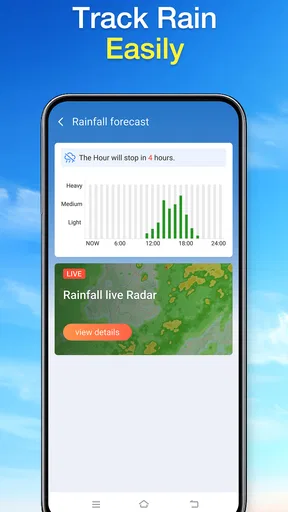
- The radar view helps you check nearby precipitation.
- Weather alerts can give you advance notice of changing conditions.
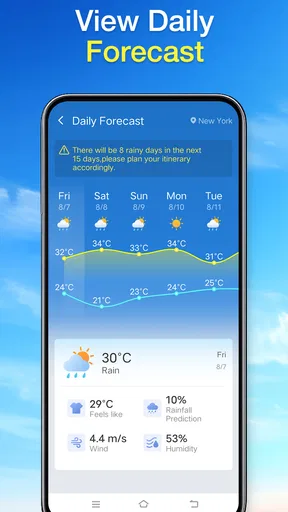
- Daily forecasts make it easier to plan outdoor activities.
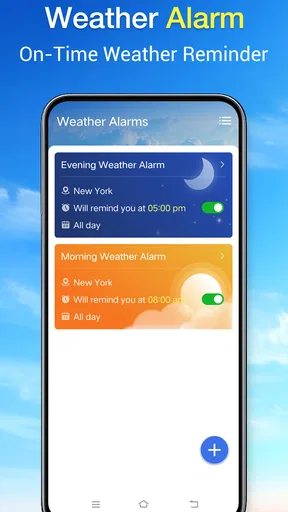
- The alarm feature can tie weather updates to your morning routine.
- Weather details are available in one focused app.
Cons
- Forecast accuracy can vary by location and provider.
- Frequent alerts may become distracting.
- Radar data may load slowly on a weak connection.
- Some features may require location access.
- The app may use battery while refreshing weather data.


